
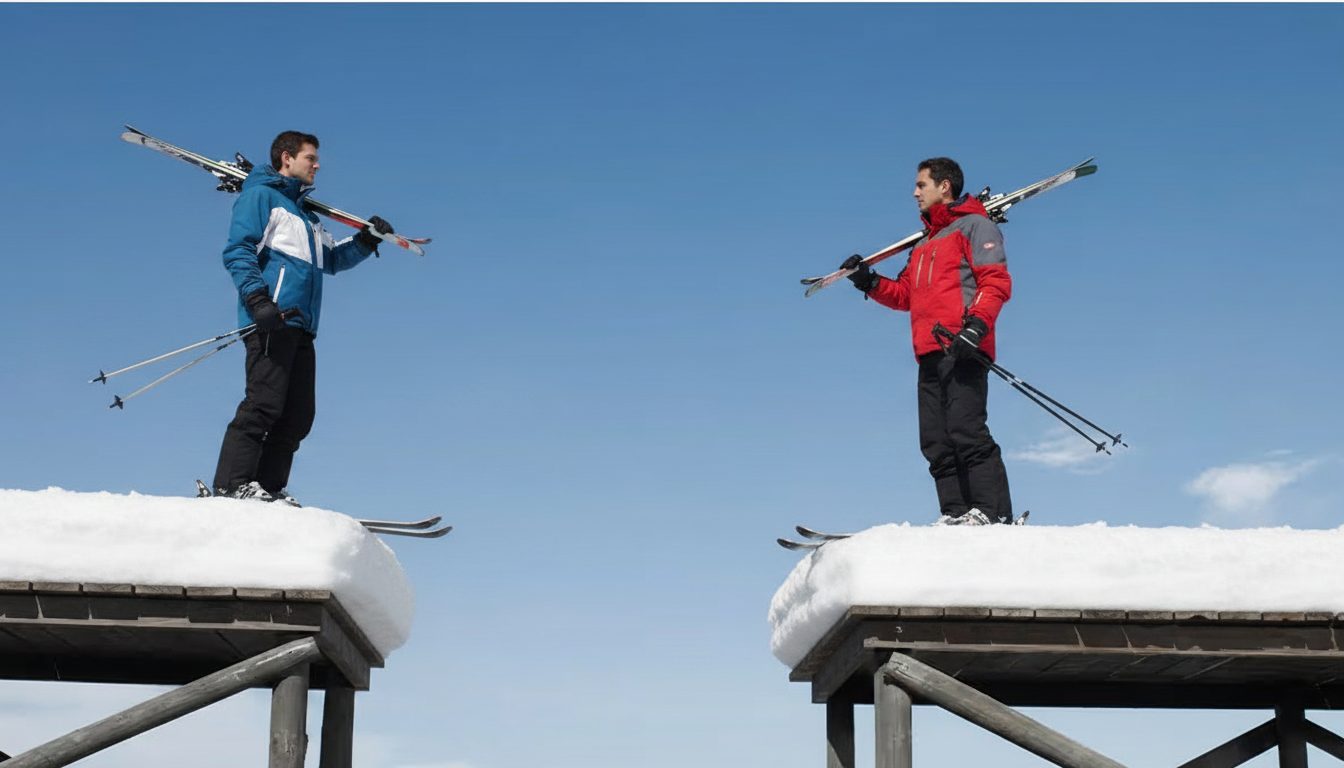
Or the two ski area problems. I never really thought of expressing this situation in terms of two organizations until I read a recent article in the Harvard Business Review. The article is written by Irina Wolpert, who leads Egon Zehnder’s North America Fintech Practice and advises boards and CEOs on succession, governance, and leadership development. She previously held senior roles at Amazon and American Express.
The following is a summary of the article provided by the author. “What if the company you’re leading isn’t the one you think it is? Most companies operate as two organizations: the polished version executives see in dashboards and boardrooms, and the messier, more revealing reality lived by employees. This gap isn’t accidental – it’s structural, shaped by reporting layers, incentives, and leadership tenure. The danger is subtle but real: strategies built on incomplete truths, problems that surface too late, and talent that quietly walks out the door. The leaders who get ahead of it don’t try to eliminate the gap—they learn to see it, surface it, and govern both organizations at once.”
I have seen this pattern more often than I would like. Executives often describe one version of reality, while front-line staff describe a very different one. I have long viewed this as a cultural issue—and still do—but this framework is useful. The author attributes much of the two-organization divide to AI. In the context of the ski area, I do not.
Every ski area that has reached a certain level of operational maturity and complexity – typically with multiple layers of leadership, established processes, and the need for alignment across teams – is, in fact, probably two ski areas operating in parallel.
The leadership version is one that exists in the budget and strategic plan and in C-suite discussions. The lived version is the one that ski area employees experience day in and day out, encompassing the quality of the work, the team's vibe, the customer experience, and the culture.
The author contends that divergence is not a communication failure but a structural feature of how scaled organizations work. And in some organizations, the gap is widening. I would contend that communication does play a part in the gap, being that the required alignment of the ski area’s goals, operational plans, processes and procedures, which align with the goals and plans, is not communicated consistently, and all leaders don’t convey the same message – communication.
The consequences of two organizations slowly accumulate: Strategy gets set on a picture shaped more by the reporting process than by the underlying reality. Operational problems surface late, often during a crisis- Christmas week, maybe- that wasn’t seen coming. The staff closest to the lived organization, the staff who feel the gap most acutely, are also the most likely to leave. Leadership makes promotional/succession decisions based on what they have been shown rather than what is true.
Divergence is Structural
The author contends that the two-organization problem doesn’t stem from individual leaders making bad decisions. Three forces produce this gap.
The first force is information layering. It is like the old game of telephone: one person shares a message, it passes through several others, and by the time it reaches the tenth person, it no longer matches what was first said. Leaders often do not receive input directly from the front line. For example, at a medium-sized ski area, a mechanic may resolve a lift issue and report it to the lift maintenance manager, who then relays it to the VP of Mountain Operations, who then briefs the leadership team. By that point, the message may differ significantly from what the mechanic originally communicated. This is the first force.
The second force is incentive shaping. People present what they believe will be rewarded. A natural human tendency. In organizations that reward green dashboards, dashboards are green. In organizations that punish surprises, surprises stop. This is human nature responding to signals.
The third force is tenure curation. The longer a senior leader has been in their role, the more deliberately the information environment has been curated and calibrated around what they are known to find useful, threatening, or unwelcome. In year one, the senior leader would have seen one ski area, but by year five, the senior leader is governing the version of the ski area that the ski area staff have learned to show him or her.
Where the Gap is Widest
The two-ski area problem is present in every scaled ski area, but it is not equally severe everywhere. Four conditions predict where the gap is most consequential:
· The scale of the function is relative to the leader’s prior experience. A ski area CEO came up through the ranks in the hospitality side of the ski area. This CEO would be well-versed in the F&B and Lodging revenue streams and operations. The gap would exist in Mountain Operations and Skier Services.
· The time since the leader last did the actual work. The ski area’s CFO, who has not closed the books in 15 – 20 years, is governing a function that has materially changed in tooling, headcount, regulatory complexity, and pace. Institutional memory is in place, but operational fluency has aged. The gap has widened.
· The number of reporting layers between the leader and the operation. In a small or small mid-sized ski area there may be 2 layers. In a full mid-size to very large ski area, there may be 5-7 layers, and in a ski area conglomerate, there may be 10 layers. Each layer adds smoothing. By the seventh layer, experience shows, the version of reality reaching the top is an artifact of careful preparation.
· The intensity of the incentive system around reporting good news. The strongest signal a ski area leader can read in their own information environment is what happened the last time someone surfaced an uncomfortable truth. If that person were rewarded, the information environment would be healthy. If that person was sidelined, no matter how justified the sidelining was, the next person will be quieter.
Appropriate leaders should take the time to reflect on where these gaps may be broadest for them. The author of the article presents the theory that the gaps cannot be eliminated and that there is justification for the reported organization and the lived organization within a ski area, and that leaders need to govern both organizations at once. I would contend that reality and truth dictate the organization, and that leadership should manage accordingly. The author presents three examples of how a leader can manage both, and I agree that what she proposes are good practices, but I don’t see the need for two separate presentations of what the ski area is and how it should be managed.
My suggestion for closing the gap is to develop a truly healthy culture where the senior leadership is behaviorally cohesive, there is complete alignment on the following six questions by the senior leadership team:
WHY DO WE EXIST?
HOW DO WE BEHAVE?
WHAT DO WE DO?
HOW WILL WE SUCCEED?
WHAT IS MOST IMPORTANT RIGHT NOW?
WHO MUST DO WHAT?
The senior leadership team consistently communicates the answers to these questions and provides clarity so that anyone within the ski area can repeat them when asked. The next step is reviewing all procedures and policies to ensure they reflect the answers to these six questions. I have oversimplified this to some extent, as there are processes many organizations have to go through to become behaviorally compatible with things such as building trust, accepting conflict to seek the truth, full commitment to alignment, putting the ski area above personal gain or benefit, and accountability.
This process will even work for the conglomerates. It becomes a little more layered, but if done right, the gap doesn’t exist because fundamentally everyone is on the same sheet of music. The key is getting everyone at the ski area aligned. I often hear, “I’m a lift operator—what difference can I make?” In many cases, that lift operator may not know the answers to the questions above and may not see why they matter. But imagine if they did. If that employee understood the ski area’s purpose, priorities, and measures of success—and felt connected to them—guest interactions would likely improve, and the work itself would be done with greater care and intention.
The same logic applies up the organization, including the VP of Mountain Operations, where the gains in productivity and guest satisfaction could be significant. I often hear leaders talk about their NPS scores, but when I ask how employees are coached to improve them, the answers are usually vague. NPS scores can be valuable, but when leadership answers the question, “How will we succeed?” it must also define clear metrics that allow the ski area to measure, week by week, whether it is living up to those answers.
Everything I am sharing is possible, and a ski area doesn’t need to spend large amounts to make it happen. Commitment and a passion for success are the main ingredients to having a healthy, successful organization.